Showing posts with label clean. Show all posts

Thursday, 7 June 2018

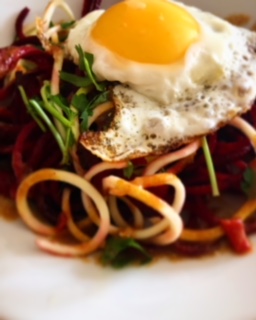
Beetroot, courgette and miso spirals with a cheeky fried 🍳

On the rare occasions that I'm at home for lunch and not rushing from client to client I like to experiment with all the random things I find in my fridge (and pretend I'm on Ready Steady Cook).
This was me wanting a healthy salad that wasn't spinach yet again so I dusted off my spiraliser (I know, it's a bit 2016) and zoodle-ified some courgette and beetroot. Whipped up a quick miso dressing and none of my salads are complete without an egg on top - this one was fried in a bit of coconut oil. Sorted.

Ingredients:

1 medium raw beetroot, peeled with ends sliced off
1/2 large courgette
1 tsp miso paste
2 tbsp lime juice
pinch of fresh chilli (optional).
1/2 tsp honey or syrup
black pepper
One large egg
2 tsp coconut oil
Coriander, parsley or mint (big handful chopped)

Method:

Spiralize the beetroot and courgette. If you've not got a spiralizer you can use the mandolin slicer on a grater (watch your fingers) or just your grater.
To make the dressing, mix the miso with a little water, the lime juice, honey, 1 tsp melted coconut oil, chilli and pepper.
Fry the courgette in the remaining coconut oil. Assemble the veg with the herbs and dressing and top with your egg. Ta da!


Tuesday, 6 September 2016

The truth about soy

In a nutshell (if you can't be bothered to read the whole thing!)

  • Soya isn’t as healthy as we thought. If you’re going to have soy products choose fermented soy (miso, natto or tempeh)
  • Don’t give soy products to kids and limit your own intake. 
  • Avoid soy if you have thyroid issues, breast cancer or oestrogen related conditions (endometriosis, breast cancer or family history of). 


A few years ago I would always order soya milk in my cappucinos, cut out dairy pretty much altogether and even ate those soya ‘yogurts’. The reason was that a. I’d heard that dairy caused spots b. I knew that my stomach had always been a little bit sensitive to too much creamy food and c. Well, Soy was generally much healthier right? Maybe not..

The more I learnt about soy products, the more alarm bells started ringing. In particular when I starting researching and found out that soya products are not recommended for young boys due to the effect that it has on female hormones and also the potential link between too much soy and certain oestrogen linked illnesses. 

Without going into the extensive research (that would be a whole thesis), here are my thoughts on why soy/soya isn't the healthiest choice:


  1. Many soya products we consume are genetically modified 
  2. Most soya products contain things called ‘anti-nutrients’ that prevent absorption of iron, zinc, calcium and magnesium
  3. Too much soya may affect the function of the thyroid, potentially leading to thyroid issues
  4. Soya contains phytoestrogens - things which mimic the female hormone oestrogen. Although phytoestrogens have the potential to decrease risk of breast cancer, it’s unsure whether they could also increase risk of breast cancer and may even affect development of sex characteristics in boys and girls (hence why it’s not a good idea to use a soy based formula or give soya products to kids!)
  5. Soya products are typically highly processed (a standard soya milk contains Filtered Water, Whole Soybeans, Cane Sugar or other sugar/sweetener, Sea Salt, Carrageenan, Natural Flavor, Calcium Carbonate, Vitamin A Palmitate, Vitamin D2, Riboflavin (B2), Vitamin B12. Compare this to the ingredients list of organic cow’s milk - milk
  6. Soya milk and other products tend to contain added sugar (a standard soya yogurt has around 3 teaspoons of sugar).

Foods you might not realise are high in soy:

Meal replacement drinks and protein powders (not going to name and shame but check the labels). 
Burger meat and buns
Breadcrumbs, cereals and crackers and breaded foods
Infant formulas and follow on formulas
Deli meats
Baking products
Nutrition supplements (vitamins)

The good news is that there is an exception to the rule:

Fermented soy products like tempeh, miso and natto are the only ways I’d recommend eating soy (tofu is out too!). This traditional fermentation process helps to make the soya more digestible and also deactivates some of the anti-nutrients.

What are the best milk alternatives?  

This will be a whole other blog but my preference would be 
1. Organic cow, goat or sheep milk 
2. Good quality almond milk (check the ingredients and % of almonds actually used - many have as little as 2% almonds and contain all sorts of added sugar, salt and weird stuff!) Making your own is really easy - blog coming soon on how to! 
3. Hemp milk (again check ingredients) 
4. Coconut milk (check doesn't have tons of added sugar) 
5. Rice or oat milk (tend to be lower in protein and higher in carbs and often sugar though). 


Veggie alternatives to soy:

Lots of vegetarians and vegans eat soy as a protein source - instead, go for beans, legumes like chickpeas and peas, lentils, nuts and seeds, quinoa, buckwheat or organic eggs and dairy (if you’re not vegan). 

Wednesday, 24 August 2016

Is 'clean-eating' all that's wrong with our attitude to food?

Many of you will have seen the BBC One doc last night 'Clean Eating's Dirty Secrets' and as a nutritionist with a qualification not bought off the internet ;-) I thought I'd share my thoughts on the #cleaneating phenomenon.

Eating Clean has taken over from veganism, raw food and Paleo in the 'buzz diets' of 2016 and you only have to take a look at Instagram to see how many people have jumped on the clean bandwagon. But what does eating clean actually mean?

There's no one set definition but clean eaters generally avoid the following:
  • refined sugar 
  • wheat
  • dairy
  • gluten
  • alcohol
  • caffeine
  • any processed foods

The hardcore clean eaters will also not eat any animal products, grains and certain types of higher sugar fruit or vegetables. Others will eat animal products providing they're organic, grass-fed or free-range.

So in essence, many of the concepts of 'clean eating' are pretty sensible - eat whole foods, avoid processed foods, and don't drink too much caffeine or alcohol. All good so far.

What isn't so good (in my opinion) is the use of the word 'clean'. This implies that any food not on the 'ok list' is somehow dirty, sinful, unpure, bad, naughty and should come laden with guilt. With so many pressures already on us, do we really need to be feeling bad because we had a glass of wine after work or a slice of white non-spelt real toast for breakfast with actual bacon and actual ketchup?
And on the flip side should we feel any purer, better, more worthy than others because we had a green smoothie for breakfast rather than a croissant?

Unfortunately I do agree with the BBC doc that the extreme clean eaters are suffering from a new kind of eating disorder and due to the sheer number of followers it now seems that these obsessive habits have been normalised. So while I'm not saying that following the general principles of 'clean eating' is harmful, to stick to them so rigidly that you feel guilty if you don't, to miss out on a social life because it doesn't fit with your food plan,  to harm your long term health for short term gains and to miss eating the foods you actually love, definitely isn't good for your health or happiness.


While I may be guilty of posting #proteinbites #greenjuice  on #instafood from time to time I would always hope that my message of happiness over denial and balance and moderation over strict rules is the one that shines through.

I'd love if we could ban the phrase 'clean eating' and let's get back to focusing on enjoying the foods in a way that we know that will make us feel good now and in the future - whether that's chocolate or cauliflower rice!

I'd love to know your thoughts on this too - feel free to comment below.